Brighter Day · A gentle writing routine
Sober journaling plan: one page at a time
A sober journaling plan is a small routine for checking in, thinking about a hard moment and choosing a next step. You do not need to write a life story or have the right words. This guide explains each prompt in Brighter Day's free three-day journal, with room to go at your own pace.
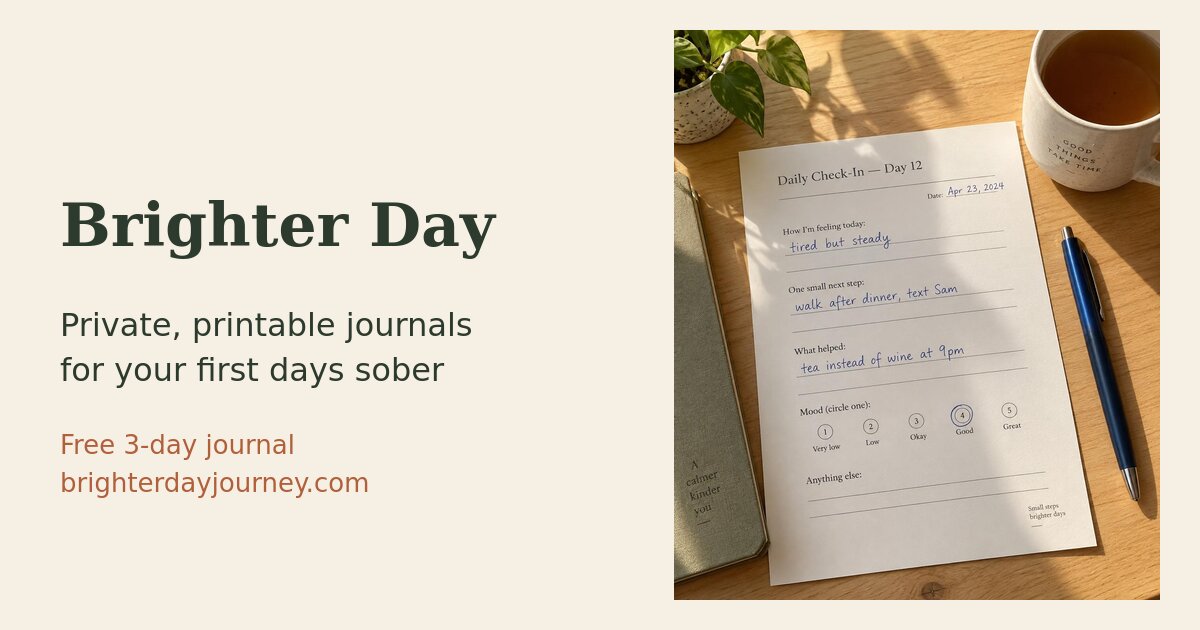
How to use your sobriety journal each day
- Choose a small pocket of time. Try a few minutes after breakfast or before bed. Five minutes can be a starting point, not a deadline.
- Open one page. Use the free sample, your own notebook or your downloaded journal. Keep it somewhere that feels private to you.
- Write briefly and honestly. A word or sentence counts. Skip a question if you are not ready for it. In the morning, answer the looking-ahead prompts; you can return to the reflection questions later.
- Leave with one next step. It might be a meal, rest or reaching out. You do not have to solve the whole week on today's page.
If writing leaves you feeling overwhelmed, stop. You can come back later, try a simpler question or talk with someone you trust.
What each sober journaling prompt is for
These are the actual questions in the free three-day journal—not extra tasks to complete. The notes below offer a way into each question, not rules for answering it.
Day 1 · Your reason and a small plan
- Why I started:
- Put your own reason on the page, rather than a reason you think you should have. One honest sentence is enough; it can change over time.
- How I'm feeling right now, in one word:
- Name where you are right now without needing to explain or fix it. A word like tired, hopeful or uncertain is a complete answer.
- What I'm most worried about losing:
- Make room for a worry instead of forcing a positive answer. You can name a routine, a relationship or something else; skip this if it feels too much today.
- What I'm hoping to get back:
- Write what matters to you, in everyday terms. It might be time, trust or a quieter morning—not a promise that sobriety will bring it back.
- The hardest moment today will probably be:
- Look ahead to a specific time or situation. Naming it gives you something concrete to plan around, rather than trying to prepare for everything.
- When that moment comes, I'll:
- Choose one small next step for that moment. Use the page's suggestions, or write who you can contact. A journal plan is not a substitute for urgent or professional help.
- One thing that was okay today:
- Notice something ordinary that was okay. It does not cancel out the hard parts, and you do not have to turn it into gratitude. If nothing comes to mind, leave it blank.
Day 2 · Notice what today needs
- How I slept last night:
- Record a simple observation, not a diagnosis: rough, okay or better than expected. You can bring ongoing sleep concerns to a healthcare professional.
- How I'm feeling right now, in one word:
- Check in again today. You do not need to match yesterday's word or show improvement.
- Something I noticed yesterday that I want to remember:
- Keep one detail you might otherwise forget: a conversation, a difficult moment or something that made the day more manageable.
- A time of day that's hard for me, and why:
- Add context to a hard moment. Write the time and what is usually happening then, without judging yourself for finding it difficult.
- One person I could reach out to today:
- Name a person you feel safe contacting. If nobody comes to mind, the recovery resources page below has meeting and support options.
- Something kind I can do for my body today:
- Pick something manageable, such as a meal, water, rest or a short walk if that suits you. This is care for today, not a new list of obligations.
- One thing that was okay today:
- Return to one ordinary okay thing. Repeating this question gives it a place on the page; it is not a test of how positive you can be.
Day 3 · Look back without grading yourself
- How I'm feeling right now, in one word:
- Start with today's feeling, even if it is the same word again. There is no correct direction for your answers to move.
- What's been harder than I expected:
- Name a difficulty honestly. A short answer can give you a starting point for a conversation with someone who supports you.
- What's been easier than I expected:
- Notice a small surprise without minimizing what is still hard. If nothing has been easier, you can say that.
- When a craving came, what I did instead:
- Write what you actually tried, or one thing you might try next time. You are recording an experience, not grading your response to a craving.
- One thing I'm looking forward to this week:
- Choose something small and real: a meal with someone, a walk or a quiet evening. You do not need a big milestone.
- A few words to myself on Day 1:
- Speak to your earlier self with the same care you would offer another person. A sentence is enough; there is no need to make the last three days sound neat.
- One thing that was okay today:
- Close with a detail from today, if you have one. An unfinished page still belongs in your journal.
How to keep going with your recovery journal
Keep the routine smaller than the pressure
On a busy day, answer just “How I'm feeling right now” and choose one next step. You can write more another day. The point is to make room for yourself, not to produce a perfect page.
Missed a day? Start with today
You do not owe the journal a catch-up session. Write today's date on the next page and continue. If you had a drink, you can write about what happened without turning the page into punishment. The after-a-drink support page is there too.
Pause for a weekly reflection
Once a week, you might look back at what felt hard, what was manageable and what you want to carry into the next week. You do not need to reread anything that feels too painful. Brighter Day's 30-day journal and 90-day journal include weekly reflections for continuing beyond the sample.
Let the journal sit alongside support
A sober journaling plan is not a detox plan, medical advice or a treatment program. If you are concerned about stopping alcohol or withdrawal, seek medical guidance rather than relying on a journal. For meetings, therapy directories and treatment searches, visit the recovery resources page.
Not medical advice. In crisis? Call or text 988 (US). Find an AA meeting near you.
Looking for housing alongside your recovery? Browse sober living homes by location — names and official websites, with questions to ask before applying.
Start with three days. Decide what comes next.
Try the free journal first. If this kind of writing suits you, explore the longer journals; there is no need to decide today.